

How to Choose a Slalom Windsurf Sail: Fin or Foil
A slalom windsurf sail is chosen on three things: fin or foil, the sizes that cover your wind range, and
Windsurf sail size depends on four things: your weight, the wind, your level and the volume of your board. You can work it out with the chart below, or answer five questions in the CHS sail size calculator and get a model and a size range.
Weight sets the starting point, but not in a straight line. The CHS calculator takes a reference rider of 80 kg and scales the sail area by the weight ratio raised to the power of 0.55. A rider of 90 kg weighs 12.5 percent more than one of 80 kg and gets 6.7 percent more sail.
The reference rider has a target area for each discipline and wind. Those targets are in the chart below, already scaled for six weights.
Target sail area in m² for an intermediate rider. Light wind is under 15 knots, medium is 15 to 25 knots, strong is over 25 knots. The chart gives the target area, so the sail you buy is the nearest size the model is built in.
| Discipline and wind | 50 kg | 60 kg | 70 kg | 80 kg | 90 kg | 102 kg |
|---|---|---|---|---|---|---|
| Freeride, light | 6.2 | 6.8 | 7.4 | 8.0 | 8.5 | 9.1 |
| Freeride, medium | 5.0 | 5.5 | 6.0 | 6.5 | 6.9 | 7.4 |
| Freeride, strong | 3.9 | 4.3 | 4.6 | 5.0 | 5.3 | 5.7 |
| Slalom (fin), light | 6.6 | 7.3 | 8.0 | 8.6 | 9.2 | 9.8 |
| Slalom (fin), medium | 5.7 | 6.3 | 6.9 | 7.4 | 7.9 | 8.5 |
| Slalom (fin), strong | 4.6 | 5.1 | 5.6 | 6.0 | 6.4 | 6.9 |
| Foil, light | 5.8 | 6.4 | 7.0 | 7.5 | 8.0 | 8.6 |
| Foil, medium | 4.6 | 5.1 | 5.6 | 6.0 | 6.4 | 6.9 |
| Foil, strong | 3.9 | 4.3 | 4.6 | 5.0 | 5.3 | 5.7 |
| Wave, light | 4.2 | 4.7 | 5.1 | 5.5 | 5.9 | 6.3 |
| Wave, medium | 3.9 | 4.3 | 4.6 | 5.0 | 5.3 | 5.7 |
| Wave, strong | 3.2 | 3.6 | 3.9 | 4.2 | 4.5 | 4.8 |
Freestyle sits close to wave: 5.6, 5.0 and 4.4 m² for the 80 kg reference rider in light, medium and strong wind. Kids and teens have their own scale, starting from 4.8, 4.2 and 3.4 m².
The chart is for an intermediate rider, someone who planes and gybes. Two adjustments apply on top of it.
For an 80 kg rider on freeride in medium wind, the chart says 6.5 m². A beginner gets 6.2. A racer gets 6.8.
A board can only carry so much sail. The calculator limits the size to what each volume class can handle, and it does so differently for fin and foil.
| Board volume | Fin sail range (m²) | Foil sail range (m²) |
|---|---|---|
| 85 to 105 L | 3.6 to 6.2 | 4.5 to 7.0 |
| 105 to 125 L | 4.5 to 7.3 | 5.0 to 8.0 |
| 125 to 145 L | 5.5 to 8.5 | 5.6 to 9.0 |
| Over 145 L | 6.0 to 9.9 | 6.0 to 9.9 |
Take a 90 kg rider on freeride in light wind. The chart says 8.5 m². On a 105 to 125 L board the limit is 7.3, so the target drops to 7.3. A larger sail would overpower the board.
The calculator also compares board volume with your weight. It uses the middle of each volume class: 75, 95, 115, 135 and 160 L. Subtract your weight from that number. Below 0, the board sinks at rest and only lives once you plane. Below 15, the volume is tight: quick once planing, demanding in the lulls. Between 15 and 45, board and body are matched. Above 45, there is plenty of volume for easy uphauling and early planing.
For wave and freestyle, volume moves the size by 7 percent at most, either way.
The range is the size below and the size above the recommended one. Use it when your spot has gusty wind or you sail with a different board.
The size tells you the area. The model depends on what you do and how hard you push. The calculator follows these rules.
One more rule: a small board changes the answer. On a board under 105 L, a freeride rider is pointed to freemove sails such as the GSstyle, or to the Bump & Jump in strong wind, whatever the wind label says.
One size is rarely enough. The chart shows a spread of 3 m² between light and strong wind for a freeride rider of 80 kg (8.0 and 5.0). A quiver of three sails covers that spread, with the middle sail on the days you sail most.
Racers follow the same rule, set by the PWA. The CHS SLX quiver for light wind is 8.5, 7.5 and 6.5 m². For high wind it is 7.5, 6.5 and 5.5. On foil, the Aero Foil quiver is 8.4, 7.0 and 5.6 m² for heavier riders, and 7.8, 7.0 and 5.6 m² for lighter ones. You can find the full detail in our guide to choosing a slalom sail.
No. Sizes are indicative, based on weight, wind and board volume. Your skill with the sail, your fin or foil and the gusts at your spot also count. A calculator gets you to the right size family. The sailmaker can refine it if you write to him from the quiz result.
Once you have the size, the shape of the sail matters as much as the area. Two articles on this site explain how to adjust it: the leech and batten tuning.
Take the quiz with your own weight, wind and board: find your windsurf sail size. Five questions, and it ends on the model that fits. If you already know you want a race sail, go straight to the slalom and speed sails or the foil performance sails.
A slalom windsurf sail is chosen on three things: fin or foil, the sizes that cover your wind range, and
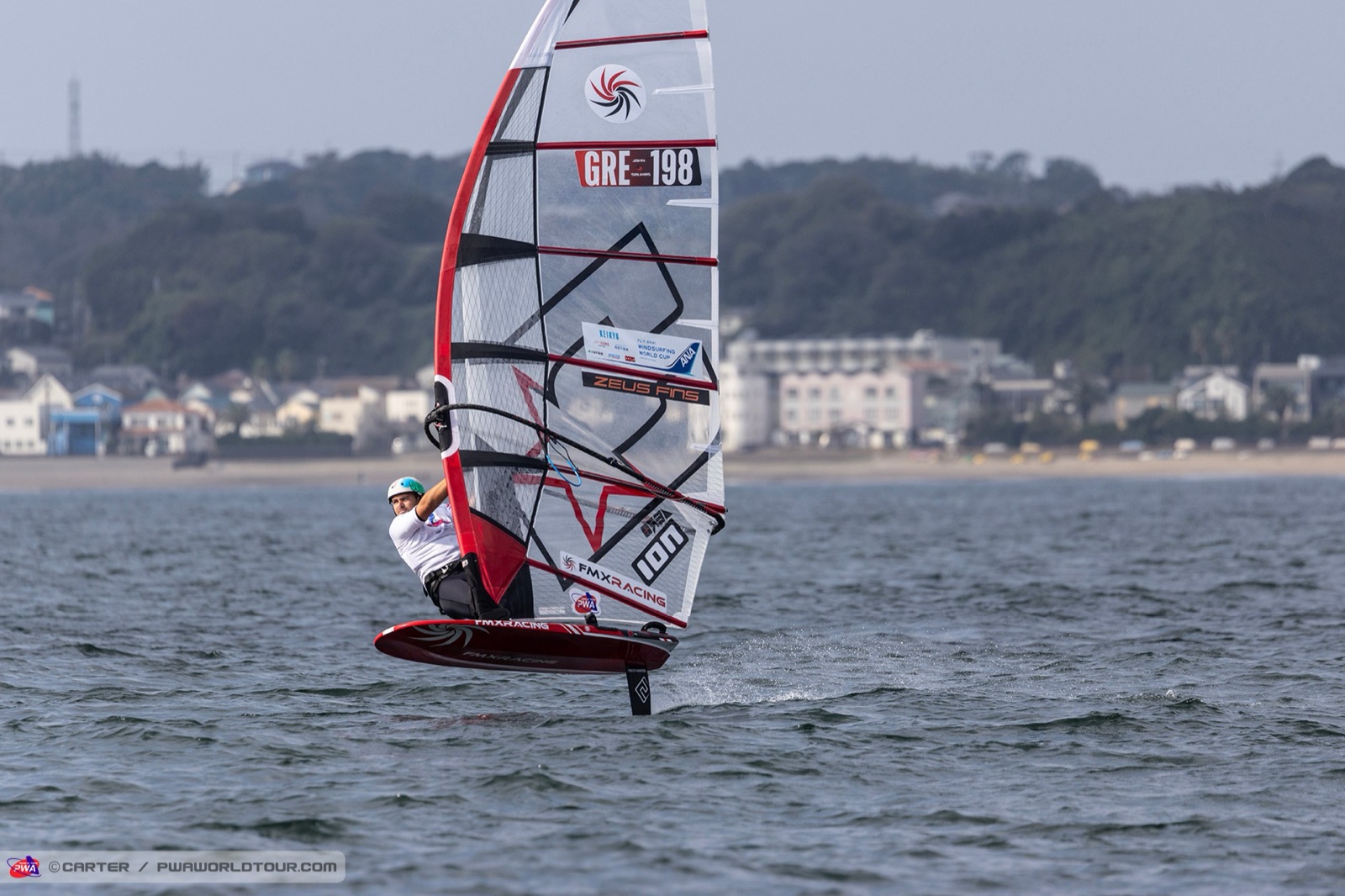
PWA World Cup Yokosuka 2026: John Soukos 8th in Japan and 6th in the Foil Slalom World Tour, his best ranking yet. Cyril Evrard closes the Tour 20th.