

Windsurf Sail Size: Weight, Wind, Level and Board
Windsurf sail size depends on four things: your weight, the wind, your level and the volume of your board. You
A slalom windsurf sail is chosen on three things: fin or foil, the sizes that cover your wind range, and the number of sails you are allowed to carry. This guide takes them in that order. If you only need the size for your weight and board, the CHS sail finder quiz gives it in a minute.
Both disciplines race on the same course, but the sail is asked to do different jobs.
The size difference is easy to see in the numbers the CHS quiz uses. For a racer of 80 kg, the target area is 8.9 m² for fin and 7.8 m² for foil in light wind. In strong wind it is 6.2 m² for fin and 5.2 m² for foil. Pick the discipline first, then the size.
The table shows the target sail area in m² for a racer, by body weight and wind. Light wind is under 15 knots, medium is 15 to 25 knots, strong is over 25 knots. The real sail is the nearest size the model is built in.
| Racer weight | Fin, light | Fin, medium | Fin, strong | Foil, light | Foil, medium | Foil, strong |
|---|---|---|---|---|---|---|
| 70 kg | 8.3 | 7.2 | 5.8 | 7.2 | 5.8 | 4.8 |
| 80 kg | 8.9 | 7.7 | 6.2 | 7.8 | 6.2 | 5.2 |
| 90 kg | 9.5 | 8.2 | 6.7 | 8.3 | 6.7 | 5.5 |
Two things change these numbers. Your board caps the size: on a 125 to 145 L board the quiz stops fin sails at 8.5 m² and foil sails at 9.0 m². And your level: beginners are sized 4 percent lower, racers 4 percent higher. For a full chart by weight, discipline and level, read our guide to windsurf sail size.
Three is the number to plan around, because that is what the rules allow on the water.
Even if you never race, the same logic keeps a quiver short. Each sail should cover a clear wind band, with a gap wide enough that you never sit between two sizes.
| Model | Setup | Sizes (m²) |
|---|---|---|
| SLX (fin) | Light wind | 8.5, 7.5, 6.5 |
| SLX (fin) | High wind | 7.5, 6.5, 5.5 |
| SLX (fin) | Lightweight rider, 4 sails | 7.5, 6.5, 5.5, 4.8 |
| Aero Foil | Heavier riders | 8.4, 7.0, 5.6 |
| Aero Foil | Lighter riders | 7.8, 7.0, 5.6 |
The SLX is built in 4.8, 5.5, 6.5, 7.5, 8.5 and 9.0 m². The Aero Foil comes in 3.9, 4.7, 5.6, 6.5, 7.0, 7.8 and 8.4 m².
Yes, and the CHS setups show how. The SLX has a light-wind setup (8.5, 7.5, 6.5) and a high-wind setup (7.5, 6.5, 5.5). The two share the 7.5 and the 6.5. What changes is the sail at each end: 8.5 for the low end, 5.5 for the top.
A lightweight rider moves the whole quiver down and adds a fourth sail, the 4.8, to keep working when the wind is at its strongest. On foil the Aero Foil does the same in a different way. Heavier riders take the 8.4 as their big sail. Lighter riders take the 7.8. Both keep the 7.0 and the 5.6.
The weight table above follows the same pattern. An 80 kg racer in strong fin conditions has a target of 6.2 m², so the 6.5 is the nearest SLX. A 70 kg racer in the same wind has a target of 5.8 m², so the 5.5 is the nearest. Ten kilos of body weight move you by one size in the same wind.
Do not read it sail by sail. Read it for the whole quiver. The Aero Foil is designed to cover from 9 knots to over 40 knots with three sails: 8.4 or 7.8 for the light end, 7.0 in the middle, 5.6 for the top. If your spot rarely goes past 25 knots, you will use the first two sails far more than the third.
Start from the wind you sail in most days, and buy the sail for that band first. The quiz uses the same logic with three bands: under 15 knots, 15 to 25 knots, over 25 knots.
Not every slalom sail is a full race sail. CHS keeps three fin options and three foil options so you can match the sail to how hard you want to push.
The results come from the riders, not from the product page. In 2026 John Soukos finished 6th in the PWA Foil Slalom Tour on the Aero Foil, one point ahead of seventh place (19201 against 19200). Daniele Benedetti won the PWA Fuerteventura Slalom Foil in 2024 with the same sail. On the fin side, Charlotte Philip was 1st Youth at the IFCA Fin Slalom European Championships 2026 with the SLX.
Size is half of the choice. The other half is how the sail is set. Two articles on this site cover the parts that riders adjust least often: the leech and batten tuning. Read them before you decide a sail is too loose or too stiff.
A sail is shaped for one job. The Force One is the nearest answer: it is developed for foil, but its balanced profile has worked for team riders on fin slalom. For racing, choose the sail made for your discipline. For training and mixed sessions, the Force One is the one to consider.
Answer five questions in the CHS sail finder quiz: discipline, level, wind, weight and board volume. It returns a model and a size range. Then browse the slalom and speed sails for fin, or the foil performance sails for foil. Not sure between two sizes? Write to the sailmaker from the quiz result.
Windsurf sail size depends on four things: your weight, the wind, your level and the volume of your board. You
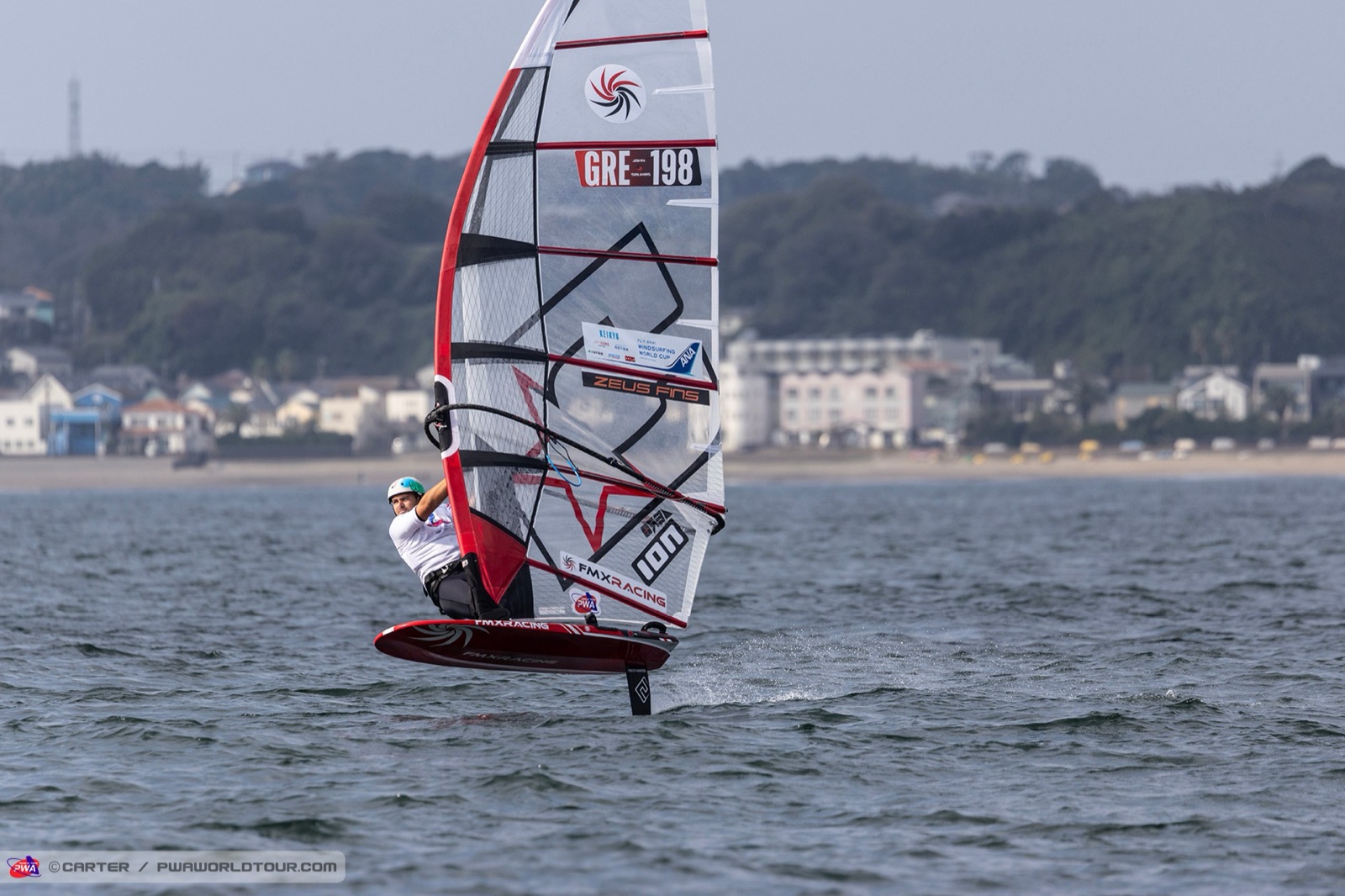
PWA World Cup Yokosuka 2026: John Soukos 8th in Japan and 6th in the Foil Slalom World Tour, his best ranking yet. Cyril Evrard closes the Tour 20th.